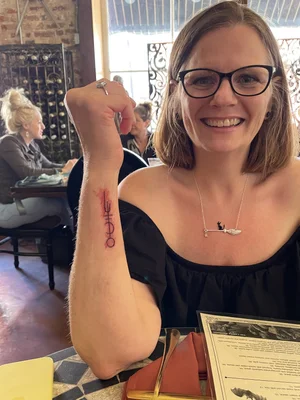
Sex vs. Gender: Untangling the Cultural Spell
A return to nature — relationship beyond rigid categories.
Before we begin, here’s a map of the terrain.
If you’ve ever felt the frustration of being reduced to a checkbox — asked to choose a category that only partially reflects who you are — you’re not alone.
Many of us sense that something about the way we talk about sex, gender, and identity feels incomplete, even when we don’t yet have language for why.
I didn’t write this post to win arguments or enforce certainty. I wrote it as a way to untangle some things. A slow unbinding of cultural ideas about sex and gender that have long fused together, often without question.
If you’re curious about nuance and what might become possible when we loosen the old cultural scripts that bind us like a too-tight corset, you’re in the right place.
This isn’t about arriving at a single conclusion.
It’s about learning to see differently.
And creating more space to breathe in your own body.
Let’s loosen that cultural corset a bit…
🌿🌿🌿
🙁 When Language Fails: The Medical Form Moment
🌊 Sex Isn’t Binary
🌕 Sex ≠ Gender
⚖️ Sex = Gender as Social Control
🧩 Sex & Gender Coexist
🧵 The Linguistic Mess We’re Living Inside
☯️ Gender Through the Lens of Yin & Yang
🌓 Pronouns & Polarity
🪞 Pronouns & Gender Identity
🔥 The Real Confusion Isn't Nonbinary Identity - It's the Fusion of Sex and Gender
🌿 A Return to Nature & Relationship
🌿🌿🌿
When Language Fails: The Medical Form Moment
Last summer, I read the U.S. President’s Executive Order 14168, Defending Women From Gender Ideology Extremism and Restoring Biological Truth to the Federal Government (link to Executive Order).
After reading it, my knickers were in a twist.
The Executive Order claims that sex and gender are different (a point I agree with), yet throughout the text it repeatedly conflates the two.
I started writing this post back then. Then life happened. The draft collected cobwebs.
Until I filled out online forms for my annual medical exam a few weeks ago.
The form asked about my “legal gender” and my “birth sex” (see image below).
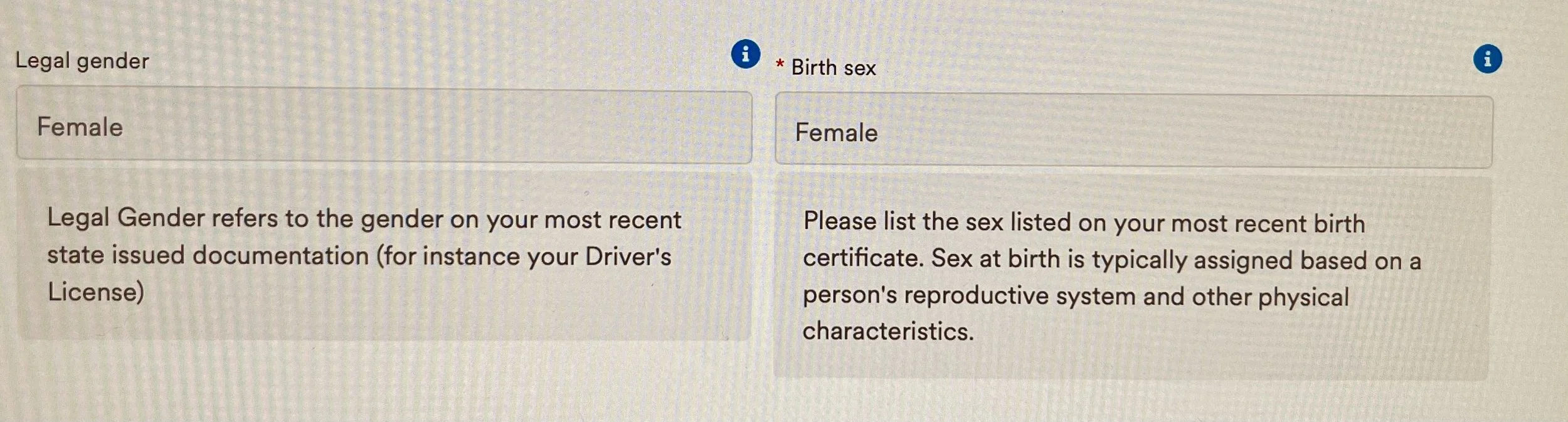
Online medical form
I paused. Scratched my head. Furrowed my brow. Frowned.
Confused, I clicked the little blue information icon to find out how they define these things.
For “legal gender” it says “…refers to the gender on your most recent state issued documentation (for instance your Driver’s License).”
Um, my driver’s license lists my sex, not my “legal gender.” 🤔
For “birth sex” it says “…the sex listed on your most recent birth certificate. Sex at birth is typically assigned based on a person’s reproductive system and other physical characteristics.”
And yet the answer options for both questions were identical:
Female or Male.
These are biological sex categories, yet they are being used to describe gender.
What the fuck?
This is a medical form from a medical institution.
Ugh.
It’s time to dust off the cobwebs.
Sex Isn't Binary
Ironically, the Executive Order correctly distinguishes biological sex from gender identity. But then asserts that sex is strictly binary (male or female).
This ignores intersex people, whose bodies demonstrate that biological sex isn’t binary because their bodies don’t fit typical definitions of male (penis) or female (vagina).
Sex refers to biological characteristics: genitals, reproductive systems, and related physiology.
Claiming sex is binary erases the lived experience of those who are born with biological characteristics that cannot easily be categorized as male or female.
And, unlike the title of the Executive Order would have us believe, biology is one layer of our truth, not the entirety of who we are.
Sex ≠ Gender
Despite distinguishing biological sex from gender identity, the Executive Order continually conflates sex and gender as if sex = gender.
But sex ≠ gender.
While sex refers to biological characteristics, gender refers to socially constructed roles and expectations that we’re conditioned into:
Boys should behave one way
Girls should behave another way
These expectations begin before birth. Long before a child can choose a gender identity for themselves.
Even “gender” reveals of an unborn child are actually “sex” reveals. Unless what you’re revealing is this: “the baby has a penis (or vagina) so I’m going to condition him (her) to fit into societal expectations of what it is to be a boy (or girl).”
I used to believe sex and gender were the same. Until 20 years ago—when I took a seminar in grad school on gender roles.
At the time, it felt mind-blowing to learn that sex and gender are different. And that we’re conditioned into gendered roles based on our biological characteristics.
What I thought was “natural” behavior for females and males wasn’t natural at all. It’s socially constructed. Stemming from conditioning that’s been passed down for thousands of years. So it seems “natural” even if it’s not because it’s so deeply engrained in us and many of us don’t question it.
The conflation of sex and gender is a harmful cultural spell that limits our self-expression, erases diversity, and impacts our health and well-being.
Sex = Gender as Social Control
As West & Zimmerman point out in their academic article Doing Gender (Gender and Society, Vol. 1, No. 2. June 1987, p. 146), “If we do gender appropriately, we simultaneously sustain, reproduce, and render legitimate the institutional arrangements that are based on sex category. If we fail to do gender appropriately, we as individuals—not the institutional arrangements—may be called to account (for our character, motives, and predispositions).”
Sex = gender is a form of social control.
If we abide by the cultural roles we’re conditioned into, then we legitimize the belief that sex = gender.
If we don’t, then we’re the ones who are held accountable (ostracized, shamed, ridiculed, harmed, stigmatized, banished, punished, killed) for deviating from those socially constructed roles rather than the people, institutions, or cultures who assigned those roles to us in the first place.
Is it just me or does this remind you of the witch burning times when we feared the alleged witches, but not the men who made up the rules and then set the witches on fire?
It begins to resemble a modern-day witch hunt, targeting people who identify as gender non-binary.
Not because they’re “witches” but because they don’t conform to socially constructed binary gender categories. Because they threaten the power structure of patriarchy.
The non-binary gender movement is quietly helping to do three important things:
✨ Separate gender (conditioning) from sex (anatomy)
✨ Show that gender is socially constructed
✨ Weaken the idea that biology determines social roles
Gender roles are not biological facts.
They’re cultural spells imposed onto bodies.
Sex & Gender Coexist
The Executive Order defines “gender ideology” as replacing biological sex with subjective identity. Here’s the definition of gender ideology in the Executive Order:
“Gender ideology” replaces the biological category of sex with an ever-shifting concept of self-assessed gender identity, permitting the false claim that males can identify as and thus become women and vice versa, and requiring all institutions of society to regard this false claim as true. Gender ideology includes the idea that there is a vast spectrum of genders that are disconnected from one’s sex. Gender ideology is internally inconsistent, in that it diminishes sex as an identifiable or useful category but nevertheless maintains that it is possible for a person to be born in the wrong sexed body.”
But gender identity does not replace biological sex.
They coexist.
Gender is disconnected from one’s sex—we’re just conditioned to believe they’re the same thing. Like the medical form that asked me about my “legal gender” and my “biological sex.”
The Executive Order also assumes we should have internal consistency:
Female bodies should align with feminine identity.
Male bodies should align with masculine identity.
But this ignores social conditioning and how conditioning reinforces the gender binary.
The Linguistic Mess We're Living Inside
Driver’s licenses don’t actually list “legal gender.” They list biological sex, be it our sex at birth or the sex on our most recent birth certificate, for example, if sexual anatomy is surgically altered.
Check out your driver’s license and you’ll see what I mean.
So what exactly is “legal gender”?
What institutions call “legal gender” is often simply a bureaucratic label. One that frequently collapses biological sex and social identity into the same checkbox.
Based on our sexual anatomy — male, female, or intersex — we’re conditioned to play out cultural roles assigned to that anatomy.
And yet our institutions—even medical ones—continue to blur these categories.
Sex can be better understood as an objective biological classification (at least as typically observed at birth: male, female, intersex).
Gender conditioning can be better understood as the roles we’re trained to play based on our observed biological sex.
Gender identity can be better understood as a subjective lived experience that may or may not conform to our gender conditioning.
Gender Through the Lens of Yin & Yang
Gender makes more sense to me when I think of the Chinese philosophical concept of yin and yang—not as female or male, but as energetic principles and polarities that exist in nature, including us humans.
Yin and yang weren’t meant to equate to biological sex, yet modern culture repeatedly forces the collapse of yin into “female” and yang into “male,” turning fluid energies into rigid roles.
This image is a reminder that polarity doesn’t belong to anatomy.
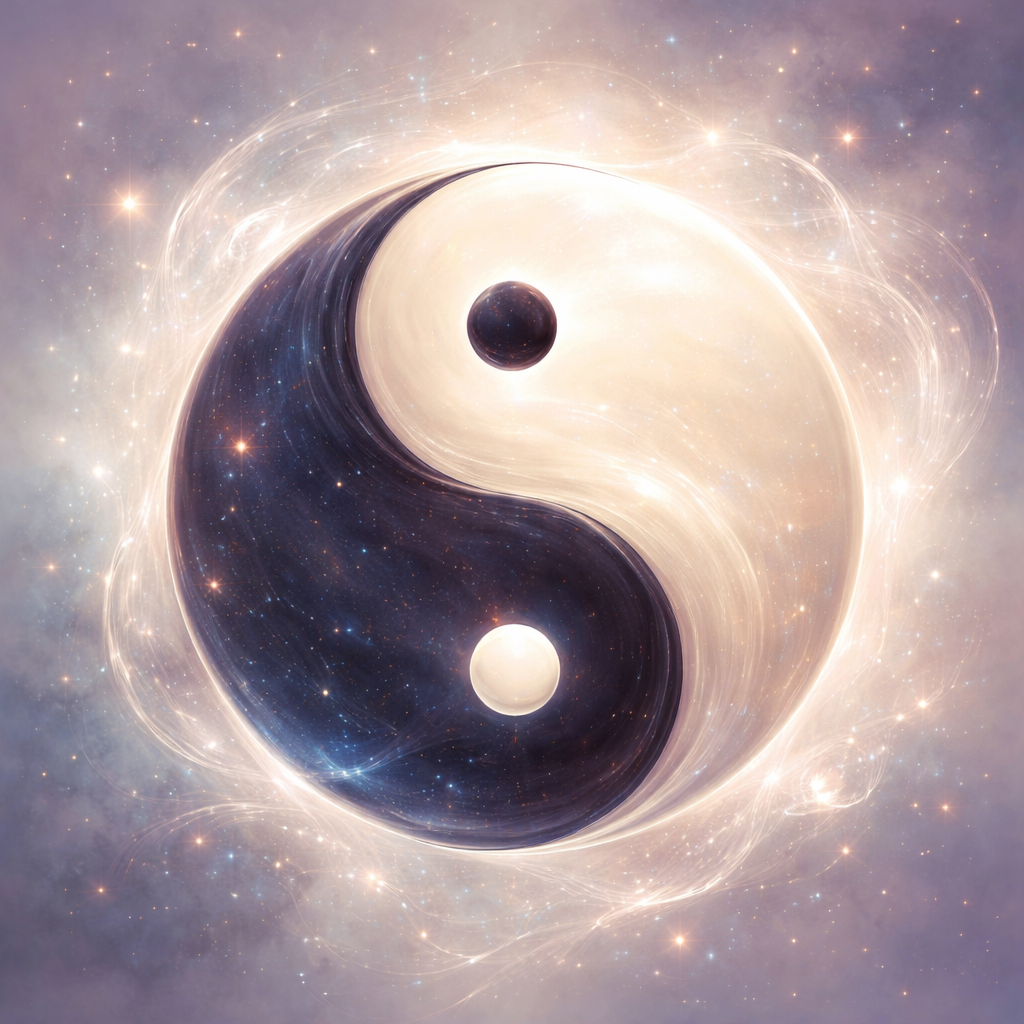
Yin & Yang
Yin and yang are energetic principles, not genitals. Yin (feminine) and yang (masculine) are characteristics of nature and humans, not biological destinies.
A penis does not own yang.
A vagina does not own yin.
These forces move through us all.
In a nutshell, yin is associated with qualities like the moon, darkness, depth, receptivity, inward movement, rest, coolness, moisture, emotion, formlessness, and the shaded side of a mountain. These qualities have often been culturally labeled “feminine,” though they are not inherently tied to female bodies.
Yang is associated with qualities like the sun, light, activity, outward movement, expansion, sharpness, warmth, dryness, clarity, structure, and the sunny side of a mountain. These qualities have often been culturally labeled “masculine,” though they are not inherently tied to male bodies.
Yin and yang are interdependent forces present throughout nature. They are not fixed states but dynamic movements that flow within us and between us, creating harmony through balance and change.
Each of us carries both yin and yang, shifting between them as life unfolds. We move into action (yang) and into rest (yin). We lean into clarity and structure (yang) and into emotion and receptivity (yin). We give, and we receive. These movements are not tied to sex; they are human expressions of energy.
Most men I know excel at resting. Does that make them “female” or “women”? Of course not. It makes them human beings expressing their yin capacity.
Most women I know excel at action — often doing far more than they have capacity for (hello, over-giving syndrome…another blog for another day). Does that make them “male” or “men”? No. It makes them human beings expressing their yang capacity.
Pronouns & Polarity
When I think about pronouns — he/him, she/her, they/them — I find myself returning to the idea that gender itself is non-binary. None of us is purely masculine/yang or purely feminine/yin. We move between these energies constantly.
When one polarity becomes rigid or extreme, imbalance emerges. Toxic masculinity reflects an overemphasis on distorted yang — relentless action, domination, suppression of emotion. But toxicity isn’t limited to the masculine. Toxic femininity can emerge when yin becomes imbalanced — excessive self-erasure, passivity, or loss of boundaries.
As a Gen X sociologist and criminologist, I know that what we call “normal” gendered behavior isn’t natural or universal. Norms shift across time and culture. Gender expectations are socially constructed — often by those in power, and often in ways that reinforce existing hierarchies.
I identify publicly as she/her. But if I’m completely honest, I also resonate deeply with they/them. Not because I reject my body as female, but because I don’t experience myself as exclusively feminine. I feel the constant flow of both yin and yang within me.
Like many female-bodied people of my generation, I was conditioned toward yang: take action, get things done, be rational, stay consistent, push through discomfort. No pain, no gain. Mind over matter.
And now I find myself consciously reclaiming yin — rest, depth, darkness, receptivity, the underworld.
The work I do guiding women through underworld journeys is deeply yin: lunar, shadowed, chaotic, transformative. And yet the yang within me builds the structure — the cauldron — that holds and contains the experience.
Chaos and order working together create sacred space.
Pronouns & Gender Identity
The current cultural conversation around pronouns and gender identity reflects something important: people are questioning long-standing assumptions that biological sex automatically determines gendered identity or behavior.
In that sense, the non-binary movement is disrupting an old narrative — the idea that anatomy dictates personality, expression, or social role. Even when people don’t articulate it in sociological language, they are challenging the historical conflation of sex and gender.
Where confusion arises is when language becomes imprecise.
Pronouns are about social identity and expression. Biological sex is about physical anatomy and medical reality. These are related but distinct domains, and collapsing them into one category creates confusion, both culturally and institutionally.
Executive Order 14168 claims to defend biological truth while rejecting what it calls “gender ideology,” yet the deeper issue is not the existence of gender identity itself.
The real problem emerges when institutions fail to distinguish clearly between biological sex and gendered social roles.
Sex is biology. Gender is conditioning, identity, and social meaning layered onto bodies.
When institutions conflate the two — whether through political policy or medical paperwork — clarity is lost, and complexity is erased.
The Real Confusion Isn't Nonbinary Identity - It's the Fusion of Sex and Gender
The deeper confusion in our current cultural moment isn’t nonbinary identity.
It’s the long-standing fusion of sex and gender: the assumption that anatomy, identity, and social role are one and the same thing.
Sex and gender are not identical. Nor are they enemies. They function more like yin and yang: distinct forces that interact, influence, and shape one another without collapsing into sameness.
In a healthy relationship, two partners remain autonomous. They do not dissolve into one another. Instead, their interaction creates a dynamic field between them.
Sex and gender may operate in a similar way. They are distinct, yet their interplay shapes how each person lives and expresses themselves.
The problem arises when culture forces a rigid script onto that relationship, demanding that one partner run the show, or that both collapse into a single identity.
That is not relationship. That is social control.
A Return to Nature & Relationship
When we allow sex and gender to remain distinct yet relational, something opens. Human expression becomes more complex, more nuanced, more alive.
And perhaps that’s why this moment feels so charged.
We are living inside a cultural moment where the old fusion is breaking apart, but the new relational language has not yet fully emerged.
Perhaps the real work of this cultural moment is not deciding which category is right, but learning to separate what was never meant to be fused. Sex and gender are not identical twins, nor are they enemies locked in opposition. They are more like yin and yang — distinct forces in dynamic relationship. Yin does not dissolve into yang, and yang does not disappear into yin; they remain differentiated while continually shaping and transforming one another.
When culture collapses sex and gender into sameness — into rigid checkboxes and simplified labels — polarity is lost and human expression becomes rigid.
But when we allow them to stand in relationship, autonomous yet interacting, something opens.
Identity becomes more nuanced.
Embodiment becomes more honest.
And if you pause for a moment, you may recognize this already within yourself. Moments when you move between structure and softness, action and rest, clarity and feeling, without needing to choose only one.
Perhaps what feels like cultural chaos right now is simply the unbinding of an old spell.
A loosening.
A remembering.
And perhaps the next time we encounter a checkbox asking us to compress our humanity into a single category, we’ll remember that the box was never the whole story.
Perhaps liberation isn’t about choosing one side of the binary, or positioning ourselves outside it, but learning how to dance with polarity as movement rather than limitation.
Nature already shows us how this works. Day does not eliminate night. Winter doesn’t cancel summer. Fall doesn’t suppress spring. The solstices and equinoxes mark turning points, not victories of one force over another. Opposites coexist, shift, and transform into one another. Not as enemies, but as partners in movement.
Perhaps the deepest confusion isn’t about sex or gender at all.
It’s the insistence that a human being must collapse into a single definition, whether through policy, paperwork, or cultural expectation.
Bodies are real. Conditioning is real. Identity is lived.
But none of these alone contain the whole of a person.
And maybe that’s the real biological truth. Not static reduction, but dynamic relationship.
I embody spring, summer, fall, and winter — all of it moving through me in lunar and solar cycles.
And perhaps you do too.
And maybe that’s enough: not to fit perfectly into a category, but to remain in relationship with what moves through us. And how it’s expressed in and through our bodies.

Love,
Heidi
If this piece stirred something in you — relief, curiosity, resistance, or recognition — you’re not alone.
My work explores what happens when we release rigid identities and step into deeper relational truth with ourselves and the world. If you’re curious about that journey, you can learn more about Virgin Sacrifice.